
For Immediate Release: July 14, 2026
 Wildlife for All Releases New National Analysis of “Right to Hunt” Constitutional Amendments as Colorado Weighs Initiative 302
Issue brief reveals national trend toward narrowing wildlife management policy in state constitutions
DENVER, Colo.—As Colorado voters prepare to consider Initiative 302, Wildlife for All (WFA) today released a new issue brief examining the growing national movement to embed hunting, trapping, and fishing as preferred wildlife management policy into state constitutions.
The report, Understanding “Right to Hunt and Fish” Constitutional Amendments, analyzes more than 140 constitutional proposals introduced across the nation in the last 30 years, documenting similarities and the evolution of these constitutional amendments.
WFA’s analysis found recent amendments increasingly go beyond recognizing hunting traditions to include language that could shape future wildlife policy by narrowing decision-making authority and restricting public input.
“Colorado’s proposal is not an isolated measure,” said Michelle Lute, PhD, executive director at Wildlife for All. “Initiative 302 is part of a decades-long national campaign to constitutionalize wildlife policy in a way that removes the adaptive capacity of agencies and takes away constituent voices. Once language is placed in a state constitution, it becomes much harder to adapt wildlife management as science evolves, threats to species and ecosystems deepen, and public priorities change.”
Among the report’s findings:
- More than 140 Right-to-Hunt proposals have been introduced nationwide since 1997.
- Twenty-nine states now have constitutional or statutory protections for hunting, fishing, or both.
- Many newer amendments include language establishing hunting as the “preferred” means of wildlife management or protecting undefined “traditional methods,” which the Congressional Sportsmen’s Foundation advises amendment authors to include to cover unpopular activities like trapping, baiting, and hounding.
- Many state proposals incorporate language from a model constitutional amendment promoted by the National Rifle Association.
- While courts have generally upheld existing wildlife regulations under earlier amendments, the broader language found in many recent proposals has received little judicial interpretation, leaving important legal questions unresolved.
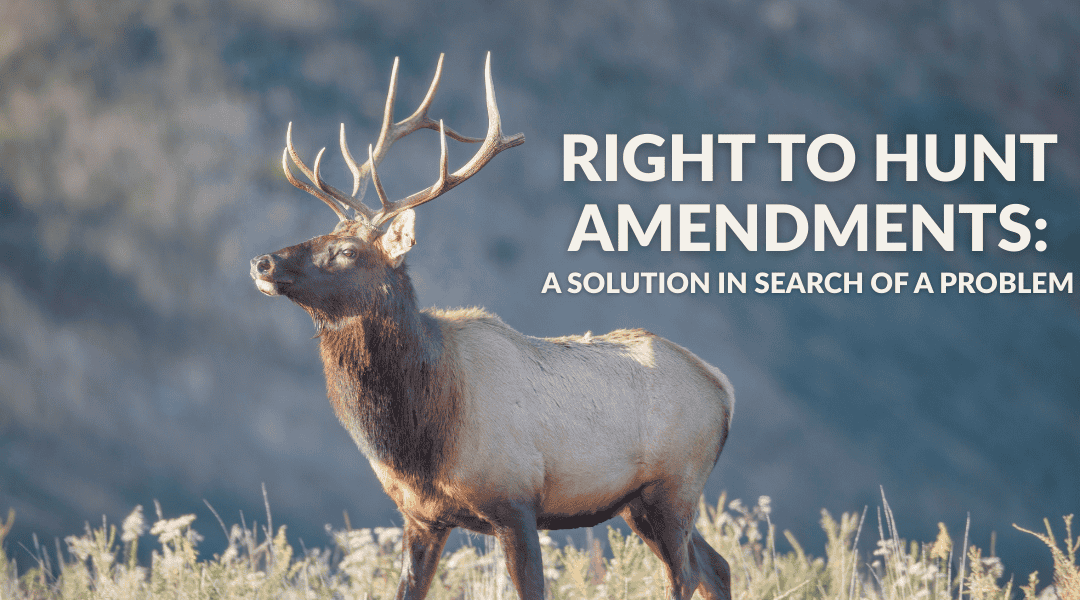
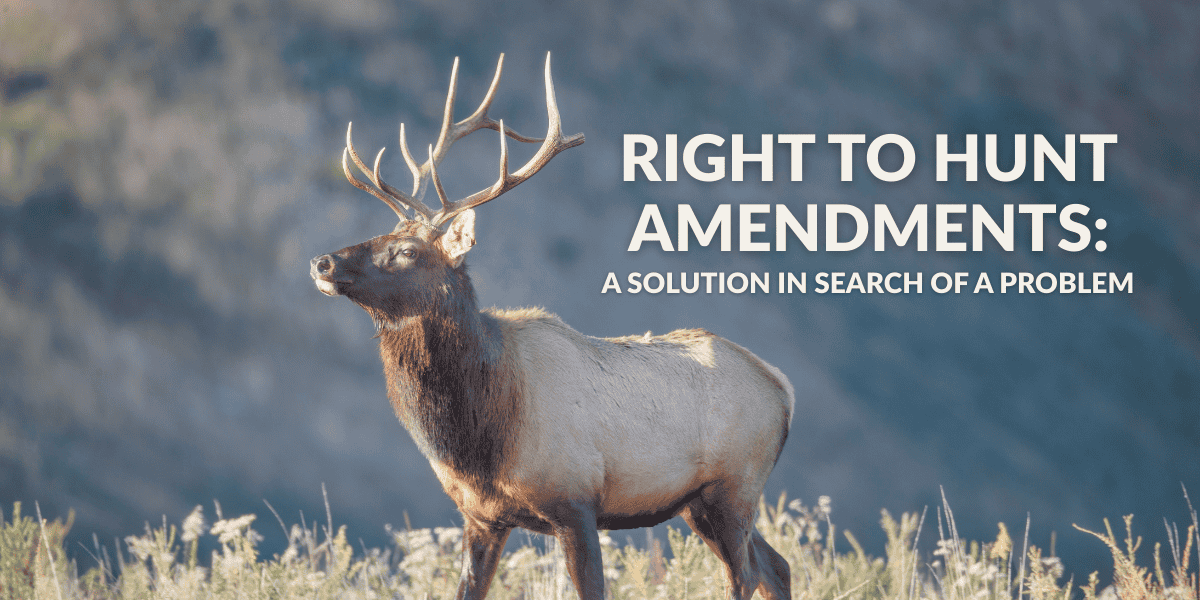
Because hunting and fishing are already legal in every state, constitutional amendments have been described by scholars as “a solution in search of a problem.” Amendments can have lasting consequences because constitutions are intentionally difficult to amend and often guide future legislative and judicial decision-making.
Lute said the issue brief is the culmination of months of research into a growing national trend and was developed to help policymakers, journalists, and voters look past slogans to evaluate proposed constitutional amendments on their merits before they reach the ballot.
“These amendments are often framed as protecting traditions,” Lute said. “But the exact wording matters. Terms like ‘preferred means of wildlife management,’ ‘traditional methods,’ and ‘forever preserve’ can narrow how wildlife is managed and biodiversity is protected, or not, for decades. Wildlife policy should remain flexible to respond to new science, emerging technical advancements, changing ecosystems, and the values of future generations.”
Colorado’s Initiative 302 reflects broader national trends documented in the report, including the use of constitutional language that extends beyond recognizing hunting to address how wildlife should be managed and who should make those decisions.
The issue brief also includes national maps, legislative trend data, comparative analysis of constitutional language, and examples illustrating how right-to-hunt amendments have influenced policymaking in other states.
The full issue brief is available at: https://bit.ly/RTHBrief
###
About Wildlife for All
Wildlife for All is a national organization dedicated to reforming wildlife management to be more democratic, just, compassionate, and focused on protecting wild species and ecosystems. Through research, advocacy, and education, we work to ensure wildlife policies reflect the values of all Americans.