
For Immediate Release: January 28, 2026
Utah’s Killing of Dispersing Wolves Exposes Fear-Driven Wildlife Management
Three Wolves Killed Near Avon as State Enforces “No Wolves” Policy
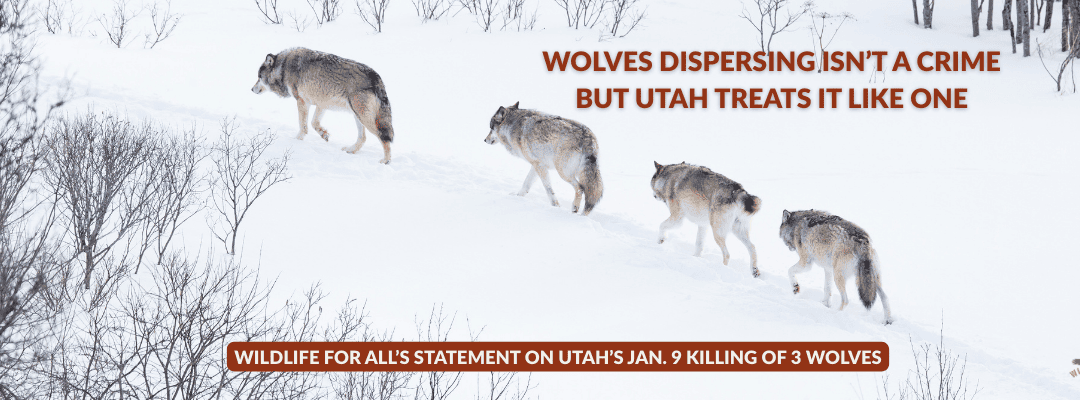
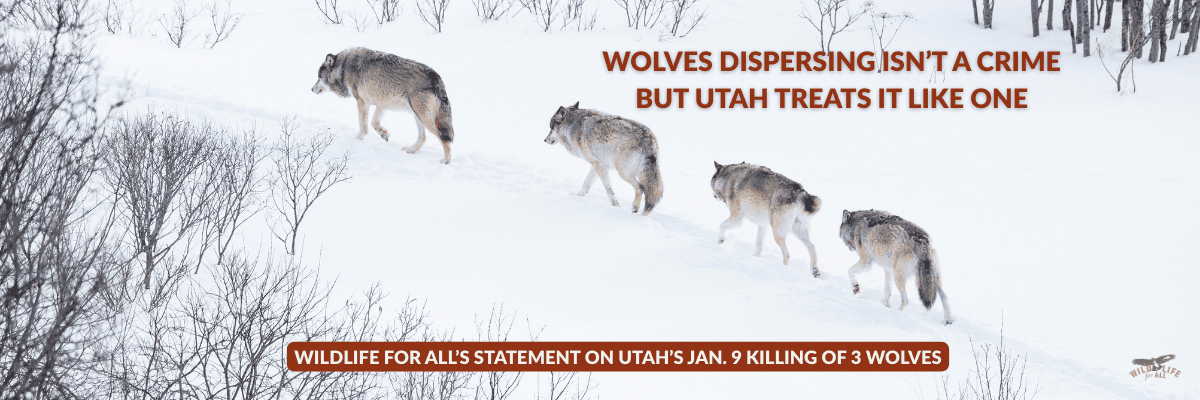
Salt Lake City, Utah—Wildlife for All condemns the lethal removal of three dispersing gray wolves near Avon, Utah, confirmed this week by the Utah Division of Wildlife Resources. The wolves were killed by the Utah Department of Agriculture and Food on Jan. 9 after state officials determined their mere presence in the state justified lethal action despite the absence of any actual conflict with humans or livestock.
Utah officials have stated there are “no established wolf packs” in the state, yet these three animals were killed precisely because they were behaving like wolves: dispersing, moving through habitat, and potentially establishing territory.
In response, Michelle Lute, PhD in wolf-human coexistence and executive director of Wildlife for All, issued the following statement:
“This is a textbook case of ‘guilty until proven innocent’ wildlife management. Utah claims it has no wolves, yet keeps killing wolves for the crime of existing in wolf habitat. That contradiction should alarm anyone who cares about science, fairness, or responsible governance.
“What we’re seeing is jurisdictional chaos masquerading as management. Colorado is restoring wolves as part of a science-based recovery effort, while Utah is killing them at its border to prevent establishment at all costs. We’ve seen this before: wolves leaving Yellowstone face similar hostility the moment they cross invisible political lines. Wildlife doesn’t recognize state boundaries, but outdated policies insist on enforcing them with lethal force.
“Utah doesn’t want the Wild West—it wants the Mild West: carnivores controlled by cleansing the landscape of their beneficial influences, ecosystems broken, and a false sense of control enforced through killing rather than coexistence. That approach may feel orderly, but it’s ecologically reckless and out of step with what actually works to protect livestock.”
Lute warned that such actions undermine conservation at a moment when dispersal into Utah is expected to increase due to wolf recovery in neighboring states. Killing dispersing wolves before conflicts are demonstrated forecloses coexistence, increases the risk of future conflict by destabilizing natural social structures, and accelerates the very ecological instability agencies claim to be managing. Lethal management also erodes public trust, as the majority of Americans value wildlife and effective, science-informed policies that protect all lives.
Nonlethal tools—including range riders, fladry, carcass removal, and livestock husbandry changes—are proven to reduce conflict where wolves are present, while indiscriminate killing does not prevent future depredations and often destabilizes ecosystems.
“This isn’t proactive management—it’s preemptive eradication,” Lute added. “As climate change reshapes ecosystems and species move to survive, policies rooted in fear and control will fail. Wolves are not the problem. Governance that refuses to adapt is.”
Wildlife for All calls on Utah officials to halt lethal removals of dispersing wolves, invest in effective nonlethal coexistence tools, and align state policy with modern conservation science and the ecological realities of a changing West.
###
About Wildlife for All
Wildlife for All is a national organization dedicated to reforming wildlife management to be more democratic, just, compassionate and focused on protecting wild species and ecosystems. Through research, advocacy, and education, we aim to protect wildlife and ensure that policies reflect the values of all Americans.