
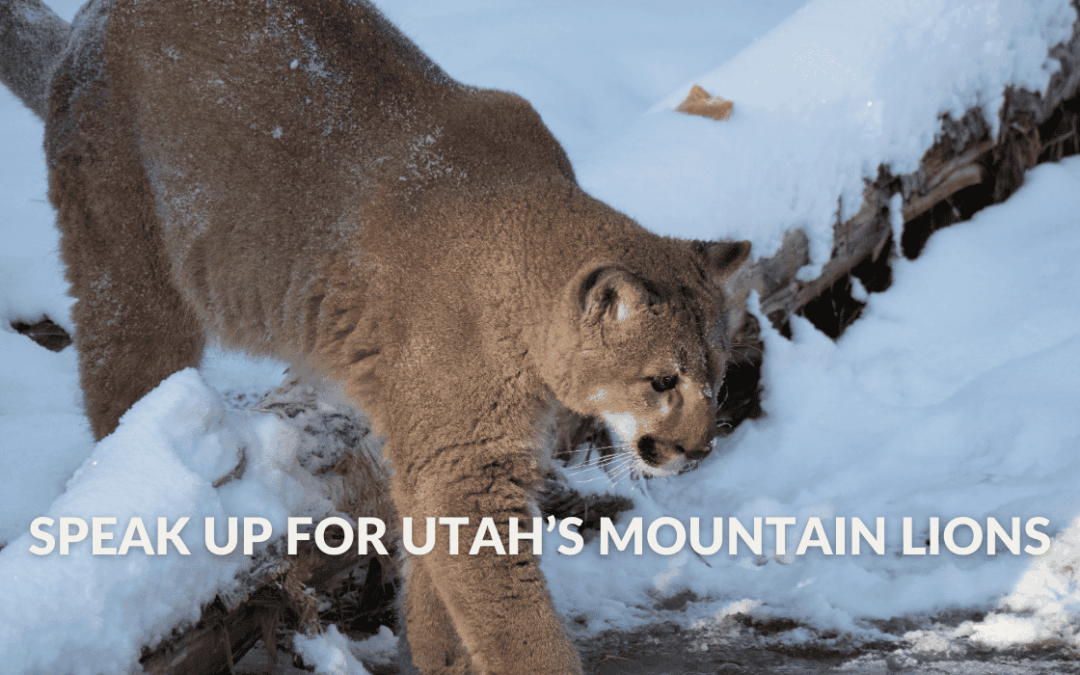
Wildlife officials are floating Utah’s cougar removal plan for multiple management units as an “experiment” to boost deer numbers.
Utah’s Cougar Removal Plan Is Not Science — It’s a Governance Failure
Utah wildlife officials are advancing a proposal to lethally remove mountain lions across multiple management units as an “experiment” to increase mule deer numbers. The proposal frames lethal control as a management tool, despite the lack of credible evidence that such actions deliver long-term ecological benefits.
Importantly, this approach did not originate from new peer‑reviewed science or from agency biologists calling for population reduction. Instead, it reflects political priorities imposed on wildlife, an increasingly common pattern across the country.
This matters because state wildlife agencies are legally tasked with managing wildlife based on science and the public trust, not political expediency.
Framing this as “science-based management” obscures a far more troubling reality: this plan fails basic scientific standards, violates ethical wildlife stewardship, and exposes deep flaws in how wildlife governance is operating in Utah.
This is not a debate about whether carnivores should exist, nor if we should coexist with them (hint: we must). It is a test of whether wildlife policy will be grounded in evidence, transparency, and public trust, or driven by political pressure and outdated assumptions.
What Is Utah’s Cougar Removal Plan?
According to statements made in public meetings, Utah’s Division of Wildlife Resources (DWR) is proposing a multi-year cougar removal program across six management units. Officials have acknowledged that:
- Cougar populations are difficult to count and current estimates are uncertain due to Utah’s harmful 2023 bill that allows unlimited, year-round killing.
- The project could run for three years or longer.
- Unreported mortality (read: poaching) is likely and difficult to monitor.
- The plan lacks baseline data, success metrics, safeguards, and ecosystem monitoring.
The stated goal is to determine whether killing cougars will improve mule deer populations. But we already know that doesn’t work … and that carnivores aren’t the reason ungulate populations decline.
Decades of peer-reviewed research across the western United States tell a consistent story: broad, sustained carnivore removal does not deliver long-term or landscape-scale recovery of ungulate populations.
Here’s why: deer declines are driven by habitat loss—not cougars. Mule deer numbers are primarily shaped by habitat quality and fragmentation, drought and climate stress, winter severity, diseases like CWD, and migration corridor loss. When these limiting factors are not addressed, removing carnivores provides little measurable benefit and is in fact, a misdiagnosis of the problem.
Further, carnivore removal destabilizes ecosystems. Large-scale cougar killing disrupts social structure, increases turnover, and can lead to younger, more transient animals moving across the landscape that can mean increased conflict with humans and livestock. And again, there is no sustained benefit to prey populations.
Even studies showing short-term prey increases involve narrowly targeted, time-limited actions, not open-ended culls across multiple units. The evidence is clear: killing cougars at this scale, without clear purpose or accountability, won’t fix deer declines and risks destabilizing ecosystems in ways that are hard to reverse.
And ask any scientist: this is not a credible experiment. A legitimate scientific study would have:
- Baseline data
- Clear success and failure metrics
- Defined parameters
- Independent oversight
- Monitoring of broader ecosystem impacts
Utah’s proposal includes none of these safeguards. There are no thresholds that would halt the project if cougar populations decline further, nor plans to assess cascading ecological effects.
Critically, this proposal was not listed on a public agenda, meaning the public was denied notice and opportunity to comment until it surfaced through questioning at a Regional Advisory Council meeting. That lack of transparency alone should raise serious red flags.
Calling this an “experiment” does not make it science. This is a high-risk culling program that shifts attention away from real solutions and places an apex carnivore at risk.
Why This Fails Ethics and Public Trust
This proposal highlights a deeper failure in state wildlife governance: State wildlife commissions are often structured to prioritize a narrow set of interests, while excluding much of the public from meaningful representation.
That is not democratic wildlife management. It is regulatory capture.
Wildlife belongs to everyone. Decisions about wild neighbors should reflect ecological knowledge, ethical values, and the democratic process, not backroom politics. Wildlife is held in trust for all people, including future generations and arguably for wildlife themselves, not managed solely to maximize one species for a single user group.
 This proposal:
- Treats an apex carnivore as expendable
- Uses uncertainty as a justification for killing more cougars, placing all of the risk on a population that is already declining
- Advances lethal methods without public consent, and at risk to their safety
- Risks irreversible ecological harm without demonstrated likelihood of benefit
Ethical wildlife management requires precaution, especially when uncertainty is high and stakes are irreversible.
Utah’s cougar proposal highlights a deeper problem facing wildlife management nationwide:
When agencies are structured to prioritize game production over ecosystem health, carnivores become scapegoats for failures rooted in habitat loss, climate change, and policy inertia.
Killing carnivores is politically easier than restoring habitat, protecting migration corridors, limiting development pressure, ending private deer breeding, or addressing climate impacts. But just because something is easy does not mean it’s effective, or responsible.
Conversely, science-informed stewardship, real conservation invests in habitat restoration and connectivity, funds nonlethal coexistence strategies, and addresses root causes of wildlife decline. This means transparent decision-making, independent scientific review of the full spectrum of scientific and ethical knowledge available, and providing for meaningful public participation.
Lethal removal, when used at all, must be narrow, temporary, evidence-driven, and precautionary, not broad, speculative, and politically motivated.
Real leadership that follows science‑informed, ethical wildlife management would center peer‑reviewed ecological research, prioritize coexistence and ecosystem health, and resist special interest interference that undermines the public trust.
Utah’s proposal does none of these things. Mountain lions are not variables in a political experiment. They are essential members of functioning ecosystems, and they deserve better than this.
Decisions this big should never happen quietly.
Speak Out Against Utah’s Cougar Removal Plan
If You Live in Utah:
- Attend the Utah Wildlife Board meeting: 9 a.m. Jan. 8 at the Eccles Wildlife Education Center, 1157 S Waterfowl Wy, Farmington, UT 84025. Show up. Speak up.
- Submit a public comment demanding transparency, science-based criteria, and safeguards using this form.
- Contact your state legislators and request oversight using this toolkit from our partner, Utah Mountain Lion Conservation.
If You Don’t Live in Utah:
- Sign Utah Mountain Lion Conservation’s petition opposing this plan.
- Share credible information about this proposal.
- Support organizations defending science-informed carnivore management with a donation or your time.
- Pay attention, because similar proposals are spreading across states.
Wildlife governance reform is not abstract. It’s happening right now, decision by decision, often out of public view. This is a political decision made within a system that routinely sidelines ecological data, public values, and best available science.
At Wildlife for All, we focus on fixing the system that produces these outcomes. Join us.