


Cougars, bobcats, wolves and other native carnivores have faced a long history of fear, misunderstanding and persecution in North America. Often they have been perceived as threats or obstacles to human interests. Though many people today recognize these species as essential to healthy ecosystems and deserving of compassion and respect, carnivores were historically marked for extermination. From the beginning, state wildlife systems were built around hunting and trapping and rooted in narratives viewing carnivores as pests rather than integral to ecosystems. Today, significant disparities still persist in the way these species are treated under the law, despite increasing high public support for greater protections.
Literature is one way we can challenge entrenched narratives. Some media reinforces negative archetypes about wildlife, portraying certain animals as good and others (like bats, snakes, wolves, or ravens) as inherently sinister or evil. However, storytelling can also inspire wonder for the natural world and foster empathy for misunderstood wildlife. Early environmental advocates like Ernest Seton – often credited with the genre of realistic animal fiction – wrote about wolves in 1898 in ways that challenged dominant narratives of the time, emphasizing noble and admirable characteristics of a maligned species.
The Wild Perspective
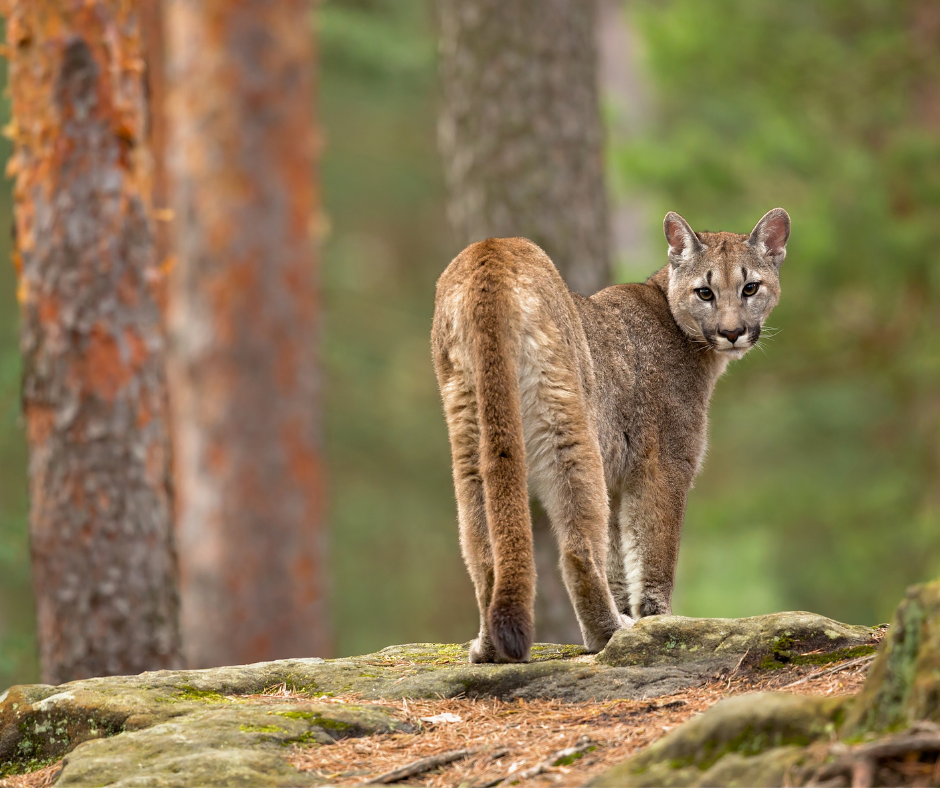
Rutherford Montgomery (1894-1985), wrote many books and short stories about western life and animals in the United States. Yellow Eyes, his story about a cougar, is set in Sleepy Cat Mountain (western Colorado) in the 1930s, while Rufus tells the story of a bobcat in Willow Creek (southwest Montana) set around the 1860s gold rush prior to statehood. Both of these settings are explored mainly from the titular wildcats’ point of view. By giving readers a chance to see the harsh and majestic beauty of wild landscapes through the eyes of a cougar or bobcat (while keeping them “purely animal”), Montgomery fosters empathy for Rufus and Yellow Eyes. Both wildcats struggle to survive in an environment inherent with many dangers – from other animals, humans, and the natural world itself. Only the human characters have dialogue, but we have access to how the animals react and respond to the events around them. This excerpt from Rufus uses sensory detail, showing how the bobcat perceives a Montana blizzard during his first winter as an independent adult:
“Clouds scudded across the sky and big snowflakes floated down through the still air. Rufus hunted as usual and caught enough rabbits for a good meal, but before he started back to his den a cold wind started to blow and increased to a gale. The big flakes changed to powdered ice, which stung Rufus’ face. Rufus had only a dim memory of what winter was like. He had slept through blizzards, curled up with his sisters in a snug den when he was little.”

Montgomery’s approach also allows readers to see and critique how settler-colonialist mindsets devalue predators as animals that exist only to be hunted for bounties or frivolous entertainment. In an early chapter of Rufus, we briefly encounter prospectors in search of gold who meet with a trapper. Tom Hardy, the leader of the prospectors, has a pack of four hounds and enjoys using them to hunt predators for sport. Once the hounds see Rufus the bobcat, they chase him into a big pine tree at the edge of a deep rocky arroyo. Rufus hisses and snarls down at the dogs – not knowing about the danger of humans and guns yet, he perceives the hounds as the main danger. Hardy decides to dislodge the bobcat from the tree with a gunshot, stating “When that cat hits the ground, you’ll see some real action as the dogs tear him apart.” Rufus feels the impact of the bullet explode as it splinters the branch beneath him – but quickly leaps away in the other direction from the hounds. By risking the long jump down into the deep arroyo and hiding in a narrow cave in the wall until the prospectors call off the hunt, he survives. Later on, Rufus witnesses the death of a wolf – killed by three gunshots from a man on a horse. These two encounters teach him that a man with a gun is dangerous and can kill from a distance, which helps him to survive and avoid humans.
At the beginning of Yellow Eyes, a government predator hunter “Cougar George” shoots a mother cougar and soon discovers she has kittens. He sets a live trap, capturing Yellow Eyes along with his two brothers Fuzzy and Runty so he can use the young cougars to train his hounds to kill. Yellow Eyes, the largest and smartest of the litter, is the only one to survive the chase – the sight of the pack of hounds mauling his two brothers becomes permanently ingrained in his memory. As a lone orphaned cub, Yellow Eyes is old and skilled enough to catch prey like jackrabbits independently, but must learn other lessons and ways of the wild on his own, such as that skunks should be avoided. As he grows up, he learns from experience and becomes a skilled hunter of deer. At the same time, he is also being hunted by Cougar George, and later on other men who relish the challenge and bounty offered for killing a cougar who has eluded many attempts before. These people see Yellow Eyes and his kind as nothing more than “varmints to be slaughtered”.
Treon, a young Native American man and subsistence hunter, is an important supporting character of Yellow Eyes. Befriending Yellow Eyes from a distance, he is the only person in the story to respect and understand the cougar, and is by far the most sympathetic human character. The way Cougar George and his friends talk about Native Americans (“they don’t have any sense…they’re all like that”) parallels their perception of cougars. During a pivotal scene, Treon discretely rubs coal oil into a deer carcass poisoned by Cougar George, making the meat unpalatable for Yellow Eyes and preventing him from consuming the poison. This passage from that scene shows the viewpoint of both Yellow Eyes and Treon:

Quote from Yellow Eyes by Rutherford Montgomery. Cougar drawing by Peggy Clark
While humans are major threats, nature itself is shown realistically as an often unforgiving place. Survival is never guaranteed even for a smart, powerful top predator, and a chance encounter can be a matter of life and death. This approach significantly differs from films like Disney’s Bambi adaptation which presents the forest as a idealized, harmonious utopia until it’s disrupted by hunters or forest fires (Felix Salten’s original novel Bambi: A Life in the Woods is a darker allegorical tale and shows predation as a natural part of the world). Yellow Eyes and Rufus must kill in order to eat, navigate changing seasons, and often face dangerous situations. Both are smart, adaptable survivors, but also are injured and go hungry at times. They experience fear, frustration, and contentment. We also see other predators, like golden eagles and wolves, realistically hunt and kill prey and pose threats to the main characters along the way. This tension increases sympathy for the wildcat characters, showing how they adapt and navigate multiple challenges to their survival.
Yellow Eyes and Rufus both find mates, sharing food and showing care and concern for them. Both the male and female wildcats are given many positive qualities, including intelligence, affection, and resourcefulness. For example, Rufus and his mate Tabby survive a rabbit plague by learning to catch other prey – frogs, crayfish, and trout in the creek. When Yellow Eyes finds an adult female of his kind, who has also lost her family to federal persecution, the two of them experience a moment without fear or worry, “only the quiet satisfaction of having each other.” Rather than simple anthropomorphism, these qualities reflect behavior and social interaction observed in both bobcats and cougars, including the sharing of food.
Historical Context
In the nineteenth and twentieth centuries, cultural narratives played a major role in state and federal persecution of native carnivores. In 1931, the United States government passed the Animal Damage Control Act, which authorized funding for “the eradication and control of predatory and other wild animals”, which targeted species like cougars, wolves, bobcats and coyotes, as well as any wildlife considered obstacles to livestock production, like prairie dogs. While carnivores posed little threat to public safety, and didn’t impact the majority of western citizens, livestock industry interests demanded a predator-free landscape and called for permanent federal bounty laws.
Predator persecution and hatred extended well beyond actual impacts on livestock, game or other human interests. As Michael Robinson describes in his book Predatory Bureaucracy, native predators were killed in the 1800s “for the commercial value of their pelts, to protect livestock, and simply because frontier progress and even frontier religion seemed to demand predator extermination.” These species symbolized “a frontier unredeemed by civilization”, reflecting a Manifest Destiny worldview that called for displacement and cultural genocide of Native Americans. As the book details, many settlers viewed the simple existence of wolves, cougars, coyotes, bobcats, and lynx as “affronts to their life’s mission of ‘improving’ the untamed landscape”.
This mindset faced little resistance even in early Euro-American conservation efforts. In the late 1800s and early 1900s, several hunters advocated for conservation laws to save species like bison and pronghorn from extinction and establish regulations for hunting game, while women provided support for national forests, tree planting, and protection for songbirds. Despite this, native predators had few public defenders and no conservation campaigns. In The Wolf In the Southwest: The Making on an Endangered Species (1983), David E. Brown noted this complicity among wildlife agencies, hunters and conservationists alike. “Sportsmen and their associations, state game and fish departments, the U.S. Forest Service, and the U.S. Biological Survey all abetted the quest [of predator eradication]; almost none among them resisted it. Nor were naturalists and protectionists a factor in hindering the [Mexican gray] wolf’s demise. No voice was raised for a rational and effective program to maintain a small but representative wolf population while one still existed.”
Central to the narrative recounted in Predatory Bureaucracy was Stanley P. Young, director of the Bureau of Biological Survey. This agency was a precursor to USDA Wildlife Services, which no longer aims to exterminate entire species but still kills thousands of native carnivores a year on behalf of private interests. He enlisted the public and hunters concerned with game species to ensure continuing funding and support for the predator-killing program, employing deliberate propaganda tactics in newspaper articles.
The Bureau used language describing entire species of native predators as criminals, labeling “The Wild Cat, the Mountain Lion, and the Coyote” as public enemies, gangsters, marauders, pests, and the animal underworld. Young extolled federal predator hunters as “soldiers of the wilderness” working diligently to “protect civilization against the desperadoes of the desert and mountain”. At the same time, the articles would downplay the cruel and indiscriminate nature of the methods used to kill wildlife, claiming that dying by poisoning was kinder than living in the wild.

The Department of the Interior produced this photo of a cornered cougar, which appears in the National Archives in the 1939 Annual Forestry Report. The caption read in part: “Although coyotes, wolves, bob cats and bears are detrimental to game and domestic animals, the mountain lion is enemy No. 1. His favorite victims are deer, horses and cattle….The above picture was taken on Salt Creek, 20 miles from San Carlos and the mountain lion was one of 5 killed by Larsen in one day.” (Public Domain)
Cougars and bobcats did not gain any basic legal protections until around the 1970s – far behind the installation of basic regulations and protections for species like deer, elk, bighorn, bison, pronghorn, ducks, and wild turkeys. For decades under the established wildlife governance system, wild cats were targets of unchecked persecution, and could be killed year round without limit, or even the requirement of a license in most cases (and still are in some states). Joe Van Wormer’s The World of the Bobcat (1963) noted that in the 1960s, 13 states still had bounties on bobcats and the rest had discontinued the practice not because they valued the bobcat, but because they considered it ineffective as a control measure and susceptible to fraudulent practices. Wildlife was seen through a purely utilitarian lens, valued only in terms of human interests. Cougars’ and bobcats’ predation on deer, game birds, and livestock was erroneously seen to outweigh the ecological services they perform.
Modern Parallels
These worldviews still persist today within current wildlife management. Narratives that portray native carnivores as threats that must be “managed” through aggressive killing are rooted in colonialism, extractive industry, and utilitarianism. Fear based narratives about certain species are tied to a perceived need for domination and control – over both the wild and the decision making process.
- Wildlife policy terms like “harvest”, “predator management” and “depredators” are used to make predation sound sinister while normalizing the killing of wildlife.
- In their list of “25 Reasons Why Hunting is Conservation”, the Rocky Mountain Elk Foundation celebrates the recovery and population growth of deer, elk, ducks and other hunted species while simultaneously devaluing cougars, bears, wolves and coyotes as nuisances, labeling the reduction of their “growing populations” as conservation (“The government spends millions to control predators and varmints while hunters have proven more than willing to pay for that opportunity”). While hunting license fees do contribute to state wildlife agency funding (which includes some conservation projects), RMEF’s definition of “hunting is conservation” has little to do with conservation biology and plays into the same historical dynamics of “useful wildlife” that should be conserved and valued versus “predators and varmints” that should be managed and controlled.
- Podcaster Joe Rogan has defended historical predator eradication, making statements like “wolves are dominant, intelligent, calculating predators that they eradicated from the west for a reason”. He vilifies cougars as threats to pets and people, arguing that cougar trophy hunting should be called “monster control”.
- The group Sportsmens’ Alliance consistently uses “scary” images of predators (often snarling wolves and cougars standing over bloody carcasses of prey) to influence a negative emotional reaction to these species. One article “The Costs of Cougars” sensationalizes cougar attacks and labels them as threats to deer hunting, claiming wildlife managers can either “feed one cougar or feed fifty families”. (Those who value cougars on the landscape and want greater protections for them are stereotyped as “uninformed urban and suburban voters”.)
Challenging the Narrative
For wild animals, individuals are often treated as interchangeable numbers within a population, without much value on their own beyond human interests. However, public attitudes towards wildlife have shifted. Science has also upended many long-held assumptions about misunderstood species. For example, Panthera biologist Dr. Mark Elbroch described how his research directly contradicted preconceptions of cougars as “solitary, robotic killing machines” only encountering each other to mate or fight. Though most wildcats don’t form large prides in the same way lions do, individual cougars exhibit social relationships, reciprocity, and altruism.
Elbroch’s research in Wyoming found an intricate social network where cougars in the study area shared resources and food with each other, without correlation to the individuals being related. The loss of certain individual cougars – especially a resident male with an established territory – disrupts that network. Cougars and other predators self-regulate, and when stable social networks are allowed to remain in place, conflicts with people and domestic animals are less likely to occur.
Experts like Dr. Gosia Bryja have noted a similar dynamic in bears and wolves, underscoring the value and biological importance of the individual. Wolf packs, as family groups, are much more likely to disband and splinter following the death of the leading male or female. Bears that exhibit bold, adventurous behavioral traits and unconventional survival strategies (passed down from mothers to cubs) are more likely to cross roads and navigate fragmented landscapes, making these individuals vital to the genetic diversity of their species, but also disproportionately vulnerable to human-caused mortality.
But science itself is only one part of the story. Telling that story in a compelling way is a critical aspect of science communication, and it’s a role we can all take if we care about wildlife conservation. Storytelling directly challenges the view of wildlife solely as populations and species, through its depiction of an individual’s story. This can take many forms – film, literature, photography, audio. An October 2025 PBS documentary titled Willow: Diary of a Mountain Lion uses footage gained from 200 different trail cameras in a female cougar’s home range in Montana. Much like Yellow Eyes, this documentary challenges dominant narratives on cougars by depicting their behavior realistically, and allowing us to see through the eyes of one. Viewers watch Willow as she raises a litter of six cubs, interacts with other cougars, and faces the challenges of survival in the wild.
Photography is another powerful tool. One wildlife photographer, Karine Aigner, followed several generations of bobcats on a friend’s south Texas ranch, dubbed “Bobcat Manor”. Over time, she got to know these bobcats as individuals, and learned from observation that they have distinct personalities and mourn losses. By providing a closer glimpse into the lives of an extended bobcat family, Aigner’s storytelling through photography is a powerful voice for bobcats. Her work provides important advocacy for the species from rural Texas – a state where bobcats have zero protection and are intensively persecuted in killing contests across much of the landscape (outside safe areas like this particular ranch). Project Coyote’s #CaptureCoexistence initiative similarly uses the visual medium of photography to highlight the beauty and value of coyotes, bobcats, and other wild carnivores, raising awareness of their ecological importance.
Advocacy for biodiversity and conservation extends beyond stating facts and figures. Storytelling can help challenge misinformation, build empathy for misunderstood wildlife, and inspire a sense of wonder and stewardship for the natural world. By showing the audience who snakes, cougars, coyotes, or bobcats are – not villains or nuisances, but wildlife deserving of understanding and respect – storytelling can challenge harmful narratives about these species and shift how they are viewed or treated. Rutherford Montgomery’s portrayal of a cougar’s battle for survival is still relevant today as in the 1930s in how it challenges narratives about wildlife – inviting us to see through a pair of yellow eyes.
This article was contributed by Peggy Clark, a Geospatial Science/Ecology student at Radford University in Radford, Virginia