
Colorado wolf 2404 is the lost Copper Creek pup who survived what no young wolf should: losing his family, a gunshot wound, and a year alone.
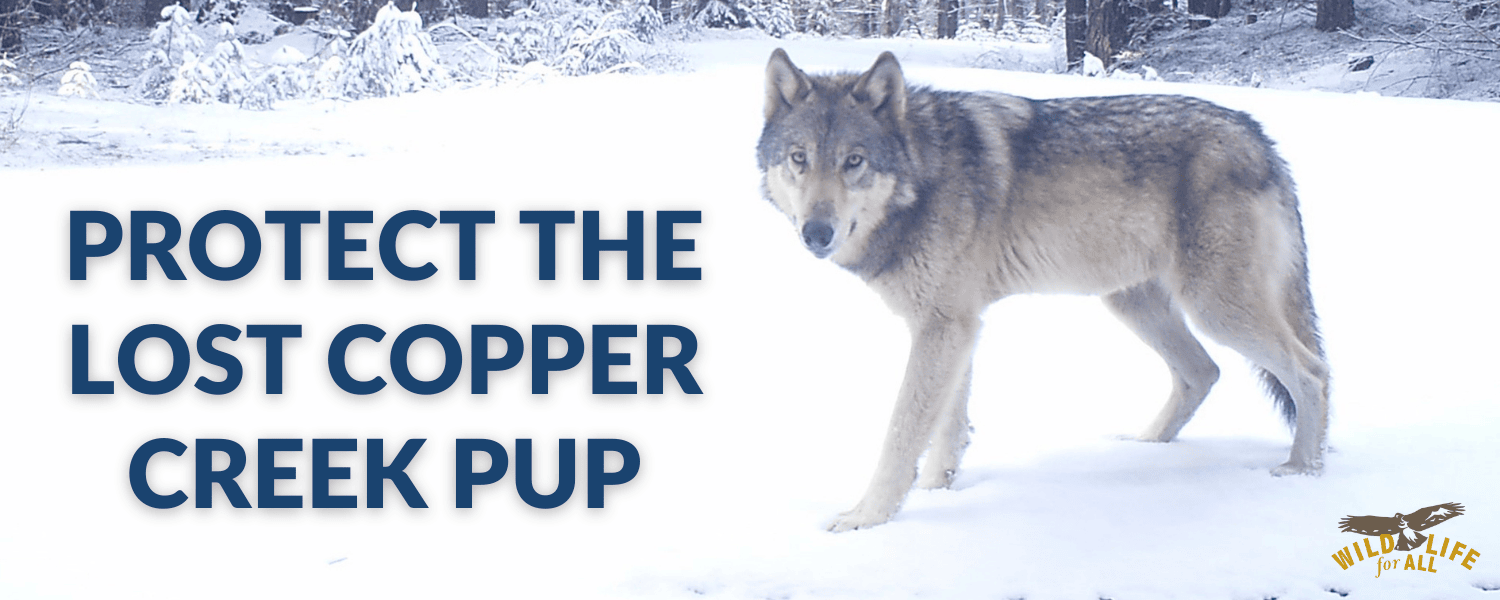
The wolf Colorado tried to kill—the one they shot and assumed was dead—is still alive.
Wolf 2404, the lost pup from the Copper Creek pack—the first pack to produce pups after wolves were restored to Colorado—has spent his entire life navigating persecution.
In August 2024, Colorado Parks and Wildlife captured the Copper Creek wolf pack to appease a rancher who wouldn’t close a carcass pit.
What happened next set off a chain of heartwrenching events that continues to unfold today.
Four pups were captured and relocated with their mother. The pack’s breeding male—wolf 2309-OR—later died from an illegal gunshot wound he had sustained before capture. The U.S. Fish and Wildlife Service opened an investigation into the illegal killing, which Wildlife for All condemned at the time as a serious threat to wolf recovery in Colorado.
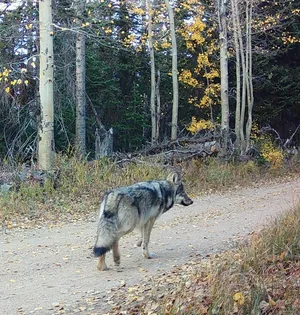 But there were five pups in the litter. One was never found, until fall of 2025 when he resurfaced in Rio Blanco County after allegedly killing a sheep.
That missing pup—this lost Copper Creek wolf—is the animal now at the center of renewed persecution in northwestern Colorado.
Against overwhelming odds, he survived his first winter alone. As we described last year in a Wildlife for All video explaining the situation, he should never have been left behind in the first place.
When he later preyed on sheep just trying to survive without parents to teach him how to hunt, Colorado Parks and Wildlife authorized lethal removal.
In August 2025, wildlife officials shot the young wolf using a rifle equipped with thermal optics. They never recovered his body. DNA evidence later confirmed he had been wounded.
But this young wolf survived against all odds.
Since then, officials have made additional attempts to kill him. According to records obtained by the Coloradoan, CPW conducted secret lethal removal operations in late 2025.
And we just learned that after a month-long search using drones and thermal imaging, Colorado Parks and Wildlife today suspended its attempt to kill the young wolf after failing to locate him in the rugged terrain of Rio Blanco County.
This young wolf’s story also reflects the broader pressures surrounding wolf recovery.
His father was illegally shot. One of his brothers was later killed by CPW. Another brother who naturally dispersed into New Mexico was captured and returned to Colorado simply for crossing a political boundary.
And throughout this time, livestock conflicts in the area continue to occur in places where basic coexistence measures have not consistently been implemented.
None of this means coexistence is impossible. In fact, research across the West shows the opposite: proactive nonlethal strategies—such as range riders, carcass removal, and deterrents—can dramatically reduce conflicts.
What this wolf represents now is something larger than a single animal.
His singular resilient life matters profoundly but he is also an undeniable reminder that wildlife recovery is not just about releasing animals back onto the landscape. It is about whether our institutions are willing to steward that recovery with transparency, science, and a commitment to coexistence.
Colorado voters chose to bring wolves back. The question now is whether the state will allow them to live.
They spent 30 days hunting one wolf with drones and thermal imaging—and failed. That’s not wildlife management. That’s futile persecution that ignores actual solutions.
Take action to protect the last Copper Creek pup. Tell CPW: no more lethal actions against this resilient wolf or any wolf—prioritize proactive coexistence solutions.