
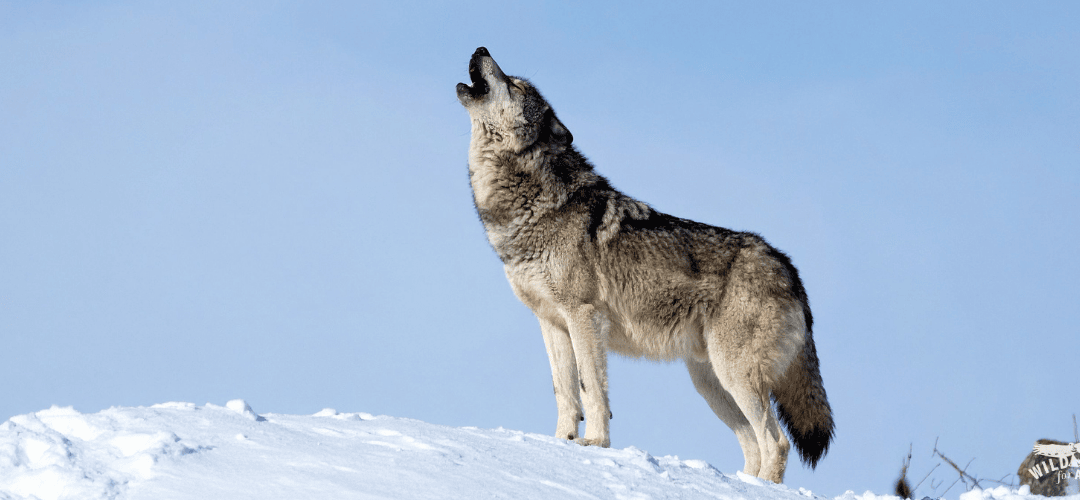
New Mexico Captures Naturally Dispersing Colorado Wolf: A Colorado wolf entered New Mexico and was immediately captured and returned because states treat natural wolf movement as a problem.
FOR IMMEDIATE RELEASE: December 12, 2025
New Mexico Captures Naturally Dispersing Colorado Wolf, Igniting Outcry from Scientists, Conservation Groups
Young wolf’s capture shows why effective recovery must follow ecology, not state lines
Santa Fe, N.M. — A gray wolf entered New Mexico from Colorado and was immediately captured and returned to Colorado—not for conflict, but because of an agreement that treats naturally occurring wolf movement as a problem.
On Dec. 11, a lone gray wolf was released back in Colorado after New Mexico Game and Fish (NMDGF) captured him roughly ten miles southwest of Tres Piedras, more than 200 miles south of his last known location. The wolf, referred to as 2403 in reference to the year he was collared (2024) and originally from Colorado’s Copper Creek pack, had dispersed from his pack’s territory earlier this fall — a normal and expected behavior for young wolves seeking new territories and potential mates.
Conservation groups are responding to the capture and forced return of this naturally dispersing gray wolf by the NMDGF, acting under a multi-state Memorandum of Understanding (MOU) designed to prevent northern gray wolves from entering the state. Under the MOU, the two agencies coordinated capture, transport and release of the wolf to Grand County, Colo. The relocation was not in response to any conflict but because, according to the CPW statement, NMDGF wants “to protect the integrity of the Mexican wolf recovery program.”
The incident highlights ongoing tension among agencies, advocates and scientists regarding recovery of both northern and Mexican gray wolves.
“Wolves disperse widely by nature and do so according to their own instinct and knowledge of the land. A single northern wolf crossing into New Mexico is not a genetic threat to the Mexican gray wolf,” said Nico Lorenzen, wildlife associate of Wild Arizona. “What is a threat and waste of limited management funding is the continued effort to police wolf movement along state lines instead of following robust science.”
“What often gets lost in the debate over wolf reintroduction and relocation is that wherever native wild canids roam, they are fulfilling their critically important niche and benefiting ecosystems,” said Michelle Lute, PhD in wolf conservation and executive director of Wildlife for All. “A wolf walking across a border is not a problem. The problem is agencies trying to herd wolves into political boxes instead of designing nature-based solutions that work with evolving, functional ecosystems, especially in an era of massive human-driven declines in wildlife diversity and abundance.”
Mexican gray wolves (Canis lupus baileyi) remain one of North America’s most endangered mammals, suffering from genetic inbreeding following their near extinction and repopulating from seven remaining wild lobos. Mexican gray wolves are on average as related as full siblings and additionally remain the target of anthropogenic mortality, including vehicle collisions and illegal killing. Scientists argue their recovery depends on greater protections, genetic rescue, northward expansion, and connected habitat that allows movement between subpopulations.
“Trapping and relocating any wolf that steps over an invisible line does nothing to advance recovery goals. Genetic integrity is maintained through robust recovery planning — not by removing every northern wolf that enters New Mexico,” said Sally Paez, staff attorney for New Mexico Wild. “This approach ignores what the science tells us about carnivore movement and long-term viability.”
The MOU among Colorado, New Mexico, Arizona and Utah requires the capture and return of wolves that cross state borders. Conservationists say the policy treats wolves like contraband rather than wildlife and undermines effective recovery.
Relocation of wolf 2403 comes on the heels of renewed attention to the Mexican gray wolf known as “Taylor,” whose movements north of I-40 earlier this year brought forward similar questions about how agencies should respond when wolves cross administrative boundaries. In both instances, wolves were exhibiting typical dispersal behavior, underscoring that individual animals can and do move across large landscapes regardless of jurisdictional lines.
“This situation shows exactly why wolf recovery cannot succeed under policies built on jurisdiction and arbitrary political boundaries instead of biology,” said Leia Barnett, New Mexico conservation lead for WildEarth Guardians. “We need updated, science-based regional management that recognizes wolves as part of dynamic, wide-ranging ecosystems.”
“This young wolf was doing exactly what wild wolves have always done, dispersing. His journey reflects both the ecological momentum of Colorado’s recovery effort and the deep permeability of the southern Rockies, a landscape wolves have moved through for millennia, long before modern state borders existed,” said Claire Musser, executive director of the Grand Canyon Wolf Recovery Project. “If recovery is going to succeed, we have to allow wolves to be active agents in that process, not obstacles to be contained.”
“Historically, gray wolf populations in western North America were contiguously distributed from northern arctic regions well into Mesoamerica as far south as present day Mexico City. Dispersing wolves moved back and forth among adjacent populations, categorized as subspecies by taxonomists,” explained David Parsons, former Mexican wolf recovery coordinator for the U.S. Fish and Wildlife Service. “The exchange of genes kept gray wolf populations both genetically and physically healthy, enhancing their ability to adapt and evolve to environmental changes. The Colorado northern gray wolf and the Mexican gray wolf that recently crossed boundaries heading in each other’s direction were simply retracing ancient pathways of wolf movements. Rather than being viewed as a problem, these movements should be encouraged and celebrated as successful milestones toward west-wide gray wolf recovery efforts.”
“The age-old connections between wolves came close to being reestablished thanks to the one-paw-after-another odyssey of a northern gray wolf who was just days away from possibly meeting the love of his life and helping to infuse the highly inbred Mexican wolf population with life-giving genes,” said Michael Robinson, a senior conservation advocate at the Center for Biological Diversity. “New Mexico Game and Fish and other agencies should respect the instinctual wisdom of wild animals as well as the recommendations of esteemed geneticists who have explained that Mexican wolves absolutely need genetic help from northern wolves.”
Background:
Colorado is in the third year of restoring a self-sustaining northern gray wolf population following voter-approved reintroduction. The Copper Creek wolf pack has become a focal point of debate over wolf management. CPW captured wolf 2403 along with his mother and three of four siblings in Grand County and relocated the family to Pitkin County. The capture process also resulted in the death of the father, who was already suffering from a gunshot wound. CPW failed to find one pup, who was left to likely starve without the help of his parents and pack. In August 2024, CPW and Wildlife Services shot a wolf in Rio Blanco County, a county away from where the Copper Creek pack was relocated to, following reports of sheep depredation. The animal’s body was not recovered, but DNA analysis later confirmed he was the missing Copper Creek pup. CPW also later lethally removed another of the pack’s pups in Pitkin County. Of the once thriving seven-member Cooper Creek wolf pack (consisting of two parents and five pups), Wolf 2403 is one of four surviving members (based on current knowledge of survivorship).
Meanwhile, Mexican gray wolves remain one of the most endangered mammals in North America, confined largely to the artificially bounded experimental population area in southern Arizona and New Mexico. Multiple wolves have dispersed north to the Grand Canyon region and northern New Mexico. The U.S. Fish and Wildlife Service in concert with NMDGF have captured all wolves — except the wolf dubbed Taylor currently roaming the Mount Taylor area — where they either remain in captivity or were released south of the I-40 boundary. Their recovery has been slowed by genetic bottlenecks, limited northward connectivity, and management restrictions that prevent the natural formation of multiple subpopulations needed for long-term viability.
###
About Wildlife for All
Wildlife for All is a national organization dedicated to reforming wildlife management to be more democratic, just, compassionate and focused on protecting wild species and ecosystems. Through research, advocacy, and education, we aim to protect wildlife and ensure that policies reflect the values of all Americans.
About Wild Arizona
Wild Arizona is a nonprofit whose mission is to protect, unite, and restore wild lands and waters across Arizona and beyond, for the enrichment and health of all generations, and to ensure Arizona’s native plants and animals a lasting home in wild nature.
About Grand Canyon Wolf Recovery Project
The Grand Canyon Wolf Recovery Project is a nonprofit dedicated to bringing back wolves to help restore ecological health in the Grand Canyon region, while also recognizing wolves as sentient beings with intrinsic value and worth.
About WildEarth Guardians
WildEarth Guardians protects and restores the wildlife, wild places, wild rivers, and health of the American West.
About New Mexico Wild
New Mexico Wild is a nonprofit 501(c)(3) grassroots organization dedicated to the protection, restoration, and continued enjoyment of New Mexico’s wildlands and wilderness areas.