
News & Commentary
What Does Noninvasive Animal Research Look Like?

Here in the United States, wildlife management has long prioritized consumptive uses like hunting, trapping, and fishing. When animals are studied, it’s typically with this lens and they are often captured using hunting and trapping techniques. Researchers at agencies and universities use leghold traps to catch a wolf to put a collar on them, hounding mountain lions to tree them for closer inspection, or trekking miles into the wilderness to leave scent lures or bait.
But Robert Long and his team at Seattle’s Woodland Park Zoo are charting a different course. Leading the charge towards noninvasive research methods, Long, a senior conservation scientist, is transforming the study of carnivores like wolverines in the Cascade Mountains.
Noninvasive research fosters a more sustainable and ethical approach to understanding and conserving wildlife. These methods, such as camera trapping and synthetic scent lures, allow researchers to gather valuable data without disturbing the animals or their habitats. Synthetic scent lures have many advantages in wolverine research; they avoid the risk of habituating wildlife to food handouts and are durable enough to last in the wolverines’ rugged and remote habitat. And unlike bait stations, dispensers don’t have to be continually replenished.
Not only is Long advocating for inclusion of ethical considerations in wildlife research on the whole, he also argues these noninvasive approaches to ensure better conservation outcomes and more accurate understanding of animal behavior and ecology. By minimizing stress on wildlife, researchers can obtain more reliable data and promote sustainable interactions between humans and animals.
With a shift toward methods that minimize human impact, Long’s work not only sets a new standard for wildlife observation but is part of a growing trend of change in how researchers look at animals: as sentient beings who deserve our respect.
Read the full article: https://sentientmedia.org/noninvasive-wild-animal-research/
Valuing Animals As Individuals

Two wolves trot through a grass field. Junction Butte Pack wolf 907F (right) trots through a field in this aerial photo from 2023. Image courtesy of Yellowstone Wolf Project.
Valuing animals as individuals is essential because each animal has intrinsic worth — including unique experiences and emotions— and a vital role within their ecosystem. Individual-level valuation recognizes the importance of compassion and ethical treatment of animals, rather than viewing them merely as parts of a species group. Without this lens, we wouldn’t be able to fully appreciate the extraordinary achievements of a wolf like 907F or a grizzly like 399.
However, because state and federal wildlife agencies often apply the North American Model of Wildlife Conservation (NAM), they often disregard the welfare of individual animals, particularly for species deemed predators or nuisances, which can lead to policies allowing their removal or even inhumane treatment.
The NAM’s focus on maintaining population levels of game species for the benefit of hunters and anglers means individual animals, especially non-game species or animals seen as “nuisance” or “predatory,” are often undervalued in management decisions.
By focusing narrowly on population numbers and hunting opportunities instead of valuing animals as individuals more broadly, management decisions of state wildlife agencies often overlook the complex roles and inherent value of a wolf when say, they authorize a kill order. And often, if individual animals are considered, plans tend to frame them only in terms of their utility or impact on other species.
As a result, even well-known and beloved individuals like Grizzly 399 are not protected from the impacts of development, human-wildlife conflict, or policies that prioritize hunting over holistic conservation efforts. The current model of thinking also discourages public engagement in conservation that isn’t in line with the way things are currently run. And this “science” ignores the growing body of evidence about the complex emotional lives individual animals lead, as well as the educational value they bring to communities, further limiting the tools available to conserve biodiversity amid habitat fragmentation and increasing human activity.
By shifting away from population-based metrics alone, agencies could adopt policies that support both the welfare of individual animals and the broader ecosystem, aligning more closely with the public’s growing concern for all species, game and nongame alike.
 That’s why we’re calling for a shift in the wildlife management philosophy to one that values animals as individuals. Decisions should be focused on compassion and coexistence, following ecologically sound and ethically responsible policies that reflect public support for biodiversity and animal welfare.
Watch Wildlife for All’s Executive Director, Michelle Lute, speak more on this.
Who Is The Anti-Wolf Lobby?

Colorado Parks and Wildlife officials release wolf 2302-OR, a juvenile female, in Grand County in December 2023.
Just ahead of the start of Wolf Awareness Week, journalists in Utah revealed that an anti-wolf lobby group fraudulently misused public tax dollars to fund its activities, highlighting the entrenched power and corruption of the anti-carnivore lobbyists within state wildlife management.
What they unraveled shows just how enmeshed—and corrupt—anti-wolf advocacy really is.
According to the Salt Lake Tribune, more than $5 million of taxpayer money was funneled to a group called Big Game Forever to both keep wolves out of Utah and work towards federal delisting.
Even though Utah doesn’t actually have any wolves, legislators gave this funding—conservation appropriations for the Utah Division of Wildlife Resources—directly to the “nonprofit” to fuel the group’s anti-wolf agenda.
This is a glaring misuse of public resources, not to mention a failure of oversight by the state wildlife agency. For years, this group received handouts of taxpayer dollars, profiteering from funds that should go to actually protecting wildlife while masquerading as a conservation organization.
Nepotism and corruption are rampant in the actions of Big Game Forever as founder Ryan Benson hired his own brother, Jon Benson, as a consultant. Jon ended up filing for bankruptcy after trying to get the state of Utah to illegally transfer state land to him for a controversial plan to dredge Utah Lake to create 18,000 acres of artificial islands. While he lost in court, a separate consulting company he led billed thousands of hours of work to help delist wolves.
It’s also fascinating to see the contractors they hired besides each other. For instance, an entity called Lumley & Sons billed 2,795 hours of public outreach work. There is no Lumley & Sons registered in Utah, but the name matches an email associated with Matt Lumley, president of the Montana Trappers Association, vice president of the National Trappers Association, and Big Game Forever’s regional director for Montana and Wyoming.
He’s the same person who caught a Yellowstone wolf in a steel-jawed trap and, instead of killing or releasing it as soon as it was discovered (per Montana law), he instead alerted Montana Gov. Greg Gianforte, who traveled hours to come shoot the wolf (also in violation of state regulations).
The scandal underscores the urgent need for reform in state wildlife management. This is not just an instance of financial mismanagement, but a broader example of how the anti-wolf lobby, led by a small handful of people, wield disproportionate influence over wildlife policy, often sidelining science and biodiversity concerns.
It’s clear now the anti-wolf lobby is formed by a network of people who all know one another and are deeply embedded in the decision-making processes of agencies that should prioritize ecosystem health and biodiversity, not special interests.
How can these groups can operate without oversight and be given such outsized voices in shaping wildlife policy, diverting public funds into each other’s pockets on the taxpayer’s dime? How many other states and other “nonprofit” organizations are operating similarly? Who else is handing contracts to cronies under the guise of conservation?
It’s time to dismantle the corrupt ties between state wildlife agencies and the anti-wolf lobby, the pro-killing special interests. We have to ensure that wildlife management serves the public good for the benefit of all species and future generations.
The ESA Is The Floor, Not The Ceiling

The Endangered Species Act (ESA) is to wildlife conservation what Roe v. Wade is to reproductive rights: the floor for change, not the ceiling.
Hear us out: The ESA has stopped wolves from going extinct, but because of lawmakers and agencies catering to narrow interests promoting indiscriminate killing, it has not done a great job at maintaining wolves in their role as apex predators with functional ecological densities.
Similarly, abortion activists relied for decades on Roe as a stopgap against the worst attacks against access. Yet that was false safety that let people feel secure with defense, and the movement never built power to fight growing anti-abortion narratives (especially after 2010), much less bills and lawsuits that slowly eroded Roe’s efficacy over time.
Now, activists are working to enshrine new state laws and develop proactive ballot measures to protect—or restore—access to abortion in their states after the June 2022 Dobbs decision that removed federal protections for abortion. “Roe is the floor, not the ceiling” was a call first issued by reproductive justice activists that has become a movement rallying cry.
Wolves are a similar issue. Sadly, they are often sold out by politicians on both sides of the aisle as political bargaining chips. And those of us who care about wolves, just like people who fight for abortion access, are behind on building the ground game to protect them.
Recovery for most species is far beyond the bare minimum back-stop the ESA provides, but that is the best tool we have at the moment. Large carnivores have critical habitats that are constantly changing with climate change, agriculture and development, and trophy hunting. The ESA is the floor, not the ceiling. It can’t bring wolves back to full species recovery, and we can’t rely on its protections forever.
“The ESA is clear: its goal is to prevent extinction, not to restore species to their pre-western settlement numbers and range,” U.S. Department of Justice attorneys wrote last month in their filing against gray wolves.
At this critical juncture, we have an opportunity to build a movement with values at its center. We need to reshape how people think about wolves and predators in general, building a culture that values their ecological roles and intrinsic value.
We also need democratically inclusive plans from states and USFWS, ones that reflect diverse public interests to protect wolves while working with the very small number of citizens who experience conflict.
On the whole, we must build an enduring movement for wolves and wildlife. We won’t sugarcoat it: this will be a long, hard slog. There are no quick fixes.
But even when decision-makers seem to ignore our voices, we must keep speaking louder and more confidently. We demand a seat at the table. This is what the hard work of culture change is all about—co-creating new systems of governance that truly reflect diverse values, interests, and voices, whether they come from the scientific community or traditional ecological knowledge or personal experiences with wild nature.
Ultimately, relying solely on federal protections leaves wolves vulnerable. Those protections can be taken away, as we’ve seen time and again. Reforming state-level governance is the key to ensuring wolves and the ecosystems they support can thrive for generations to come. This is how we secure a lasting future for wolves—not just through litigation, but through lasting change in how states manage wildlife.
Watch our full webinar on how to create state-level change for wolves, and get involved today.
The Power of People Who Care

People who care are powerful when they use their passion to advocate for change. We know fighting for change in environmental and wildlife issues can feel overwhelming but it’s really important to remember that the actions of every single person can really add up.
There are actions you can take, right now, that can change the course of a state agency or commission. Don’t believe us? This one example might change your mind.
After seeing a post by the New Mexico Department of Fish & Game (NMDGF) about a wildlife killing contest for all four species of squirrel in the state, a small group of activists—including Wildlife for All Board Member Denise Fort—jumped into action.
They posted on social media, used their networks to tell others, and Denise even fired off this opinion letter to the Santa Fe New Mexican:
Promoting the killing of squirrels? Our NM Game and Fish Department has shown again why we need to reform this agency and, joining other states in the recognition that wildlife matters to all of us. The agency in charge of conserving wildlife instead recently announced a hunting killing contest, promising rewards for shooting four different species of squirrels. They’ll even post pictures of the dead creatures. Is this what a state agency should be doing? To be clear, New Mexico is advertising itself as a beautiful destination where one can enjoy our landscape, sky and wildlife. Yes, people hunt and fish, and some people eat squirrels, but Game & Fish shouldn’t push the killing of any wildlife. As a state, we decided that coyotes don’t deserve to be killed for cash and prizes. Why would squirrels? Wildlife killing contests are abhorrent. Governor, please help.
-Denise Fort, board member, Wildlife for All
New Mexico banned coyote killing contests, where people win cash and prizes to kill coyotes, in 2019. Why should squirrels be any different? Killing contests are unethical, aren’t “management” and cause a lot of pain and suffering just for the gratification of the participants.
Word quickly spread about this squirrel killing contest. People joined in sharing the post, and called the Department and elected officials to register their opposition to a killing contest.
The Department of Fish and Game canceled the contest, and a reporter even reached out to Denise and other activists to write an article about their actions.
When people used their voices to call out NMDGF for spending its resources to promote hunting and fishing in ways that commodify and disrespect animals, rather than spending money on authentic conservation, it stopped a killing contest. And while that doesn’t happen every time, it’s an important victory to celebrate today.
Our voices can make a tangible difference when it comes to helping state wildlife management agencies modernize their focus to truly make their mission about conservation of all species. They also need our help in creating new sources of funding that prioritize biodiversity protection, not just “hook and bullet” activities.
Feeling defeated or overwhelmed is an easy reaction to the uphill battle we’re in to change an entrenched system.
But consider this: your compassion that leads you to feel this deeply is actually a source of strength. Your internal capacity to be devastated by animal cruelty is actually what makes you powerful, because it’s what motivates you to create change.
What you do matters. You are not alone.
For every Rachel Carson or Martin Luther King, Jr. or Dolores Huerta, there are millions of people whose names we don’t know but who join the fight every day, in many different ways.
Take action: share your thoughts on social media, spread awareness in your community, show up to meetings and write public comments. It all adds up, perhaps more than you know.
Give what you can with your talents and capacities, while recognizing the responsibilities in your life. If we are united in vision, strategy, and passion: we can change culture, win policy, and build a movement.
Ready to get involved? Download our Advocacy Toolkit to start making change in your state.
New Mexico Game & Fish Cancels Squirrel Killing Contest

An Abert’s squirrel sits in a bed of leaves looking at the camera in Bandolier National Monument.
It’s easy to understand why it’s hard for some people to understand science-based conservation. After all, reading tedious regulations and research papers isn’t everyone’s cup of tea.
Good thing it’s ours.
After seeing our name pop up in a recent article from a popular hunting magazine, we couldn’t help but wonder: what made us so famous?
Turns out, a Wildlife for All board member, along with other concerned citizens in New Mexico, helped to stop a hunter recruitment event that was functionally a wildlife killing contest.
From the (now removed) New Mexico Department of Fish & Game (NMDGF) Facebook post: 
Harvest one of each of the four small-game squirrel species (Abert’s squirrel, fox squirrel, gray squirrel and red squirrel) within the state of New Mexico. Take a photo of each. Submit all four photographs to the Department. Hunters who complete the challenge in New Mexico will receive special awards, and their photographs will appear on this page.
Note the use of the word “harvest.” Also note that this post is encouraging said “harvest” simply to win “special awards.”
We’re opposed to wildlife killing contests, where people win cash and prizes to kill wildlife, on basic moral grounds and because of their general lack of scientific grounding.
Killing contests are unethical, aren’t “management,” and cause a lot of pain and suffering just for the gratification of the participants. Even though this was termed a “challenge,” let’s call a spade a spade: this was encouraging killing for the sake of killing.
And while the article about us states that this can’t possibly be a killing contest since New Mexico banned those, they’re mistaken. New Mexico banned wildlife killing contests only for coyotes in 2019. There’s no prohibition on holding a killing contest in the state for other species.
What’s more, the article critiques Wildlife for All and others opposed to this killing contest as people unfamiliar with the state’s wanton waste laws, or laws that require hunters to take the edible portions of game animals so as to not waste them after killing them.
Once again, this article is incorrect and unsurprisingly only shows a partial understanding of New Mexico’s laws. The statutory requirement that edible parts of game animals be consumed does not apply to squirrels (or pikas, marmots, bears, javelinas, and cougars).
Perhaps more worrisome than a critique that is only partially grounded in an understanding of current law is the fact that this same critique is untethered from any science as well.
The leading mammalogist in the state wrote in response to this killing contest that, “Sustainable hunting requires data on animal distribution, population demographics across time, and hunter take. These types of information for New Mexico’s tree squirrels have not been the subject of rigorous scientific study. Rather, these mammal[s] are managed mainly by tradition, rather than rigorous science.”
She goes on to describe the four species of squirrels present within the state of New Mexico, two of which are listed as Species of Greatest Conservation Need (SGCN) in the New Mexico State Wildlife Action Plan (SWAP), which is actually being revised right now.

An Arizona gray squirrel eats an acorn on a tree limb Photo by Focused On Nature via Flickr
SGCN is a designation states give species who are in need of additional research because not much is known about their population or range, or are danger of declining to the point where they might need to be listed on the state or federal Endangered Species List to prevent their extinction.
So when NMDGF spokesperson Darren Vaughan says in an emailed statement that the contest was canceled “because of public misperception regarding the opportunity’s intent … as well as a lack of awareness surrounding regulations set by agency biologists to conserve squirrel populations,” we’re curious.
Whose lack of awareness is Mr. Vaughan referring to? We know the NMDGF employees are hard-working and dedicated folks who serve the state as best they can with limited resources, an outdated mission, and an incomplete scope of authority. Yet this case does feel a bit like the left hand didn’t know what the right hand was doing.
Of course, we want to assume best intent. Perhaps when a group of people used their voices to call out NMDGF for spending resources to promote a killing contest that commodified and disrespected animals—rather than spending money on authentic conservation—someone inside NMDGF raised a red flag when they realized that two SGNCs were on this killing contest’s “harvest” list.
Why? Well, something else only people who are deeply involved in conservation might know is that the state’s SWAP is being revised right now, something that only occurs once per decade.
 New Mexico’s list of SGCNs is growing rapidly because of the challenges all wildlife in this country is facing: climate change, habitat loss and fragmentation, hunting pressures, and conflict with humans. That makes the addition of two SCGN species in this killing contest even more egregious.
We applaud those who opposed this killing contest based on their values, their scientific knowledge, and frankly, just using their good ol’ common sense.
This situation clearly demonstrates that state wildlife management agencies MUST modernize their focus to truly make their mission about conservation of all species. It’s also clear they also need our help in prioritizing biodiversity protection over hunter opportunity. There are many native, nongame species that need funding, but sadly the current wildlife management system and funding structure incentivizes the department to focus on recruiting more hunters and anglers through contests like these to sell more licenses and therefore qualify for more federal dollars: wash, rinse, repeat.
It’s why we’re helping to advance legislation that will not only help modernize the mission of NMDGF but also equitably increase license fees to help fund its mission. And we’re committed to helping the department find other, diversified sources of funding, too, so that they can focus on saving all the wildlife of New Mexico, even its squirrels.
Learn more about State Wildlife Action Plans with our primer on how to get involved in your state.
Florida Wildlife Federation joins growing list of opponents to Florida “right-to-hunt” ballot initiative
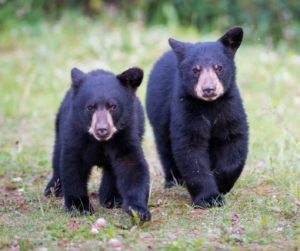
The Florida Wildlife Federation is the latest group—and the first sportsmen’s organization—to announce its opposition to the so-called “Right to Hunt” amendment on the November ballot in Florida.
On its Facebook page, the Federation explained that it has always “supported hunting and fishing in balance with science-based wildlife management.” The Federation said it opposes the amendment because it “introduces unnecessary interference with the Florida Constitution and is overly vague in its language, leaving it vulnerable to misinterpretation or misuse.”
Hunting and fishing rights are already protected under Florida law. Supporters of the amendment seek to enshrine an undemocratic status quo, arguing that hunting and fishing should be prioritized because it directly funds conservation (more accurately, hunting licenses and Pittman-Robertson revenue largely fund state wildlife agencies, whose activities and policies focus primarily on hunting and fishing management and are sometimes at odds with conservation).
The FWF joins a growing list of opponents to the measure, including Wildlife for All, the Florida Democratic Party, and the Florida Chapter of the Sierra Club.
We encourage you to share your thoughts with FWF by leaving a comment on their Facebook post to join us in thanking them for taking a principled stance on this important issue.
Why State Wildlife Agencies Must Modernize
State wildlife agencies should focus their efforts on conserving ecosystems and protecting endangered and threatened species.
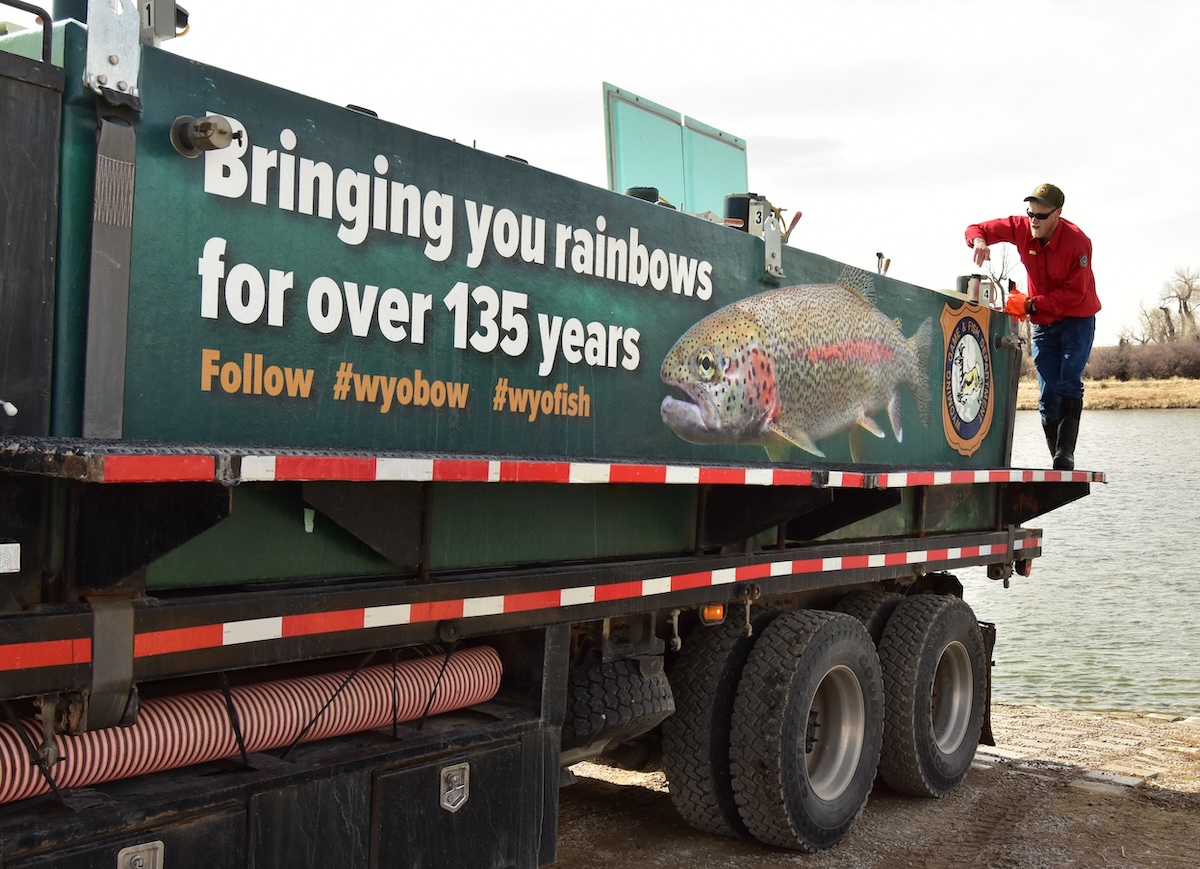
Why State Wildlife Agencies Must Modernize
As we stand on the precipice of the sixth mass extinction—this one driven by human activity—wildlife management decisions are more critical than ever.
Earth’s biodiversity is in crisis. Scientists estimate that species are going extinct at rates hundreds to thousands of times higher than the natural background rate, largely due to human activities such as habitat destruction, climate change, pollution, and overexploitation.
As ecosystems crumble under the pressure of human-caused disruptions, the extinction of species creates a ripple effect, destabilizing the delicate balance of our planet. Simply put, if our wild neighbors don’t survive, neither do we.
In light of this, state wildlife agencies should focus their efforts on conserving ecosystems and protecting threatened and endangered species. However, these agencies often prioritize increasing populations of game species for improved hunter opportunities over protecting biodiversity. Why? Mainly because their work is driven in large part by an outdated model that relies on hunting and fishing license sales, hardly a sustainable or equitable funding source.
This approach, focused on short-term gains, can have devastating long-term consequences for ecosystems already under immense pressure. Moreover, these myopic policies—focused mostly on game animal propagation as if they are cash crops—are harmful to biodiversity protection and ultimately misguided in a time when conservation should be our top priority.
The Source of the Problem: Outdated Funding Mechanisms
The current funding model for state wildlife agencies is heavily reliant on hunting and fishing license revenue. With the decline of hunting, trapping, and fishing across the U.S., this is becoming increasingly unsustainable and limits the scope of wildlife conservation.
Moreover, this funding structure creates an inherent bias in wildlife management decisions, prioritizing game species over broader biodiversity and ecosystem health. State wildlife agencies are often incentivized to manage wildlife to maximize trophy hunting (and all types of hunting and fishing that require a license be purchased) opportunities, even though non-consumptive uses, such as wildlife watching and biodiversity conservation, are growing in popularity and contributing significantly to local economies.
Already, much of this funding is actually generated by non-hunting and fishing sources. For instance, despite misconceptions to the contrary, 73% of Pittman-Robertson funds come from non-hunting sources. Our research shows PR funds only account for approximately 15% of SWA revenues on average (though that percentage is increasing). And across all states, about 53% of agency revenues on average are generated by hunters and anglers, though this average does vary greatly in specific states with some holding more diversified revenue streams than others.
Diversifying funding to include sources like general tax revenues, outdoor recreation fees, or dedicated conservation funds would allow state agencies to manage wildlife for the benefit of all species and users. These new, equitable sources of funding could ensure that state agency employees, who are often underfunded and overworked, are given adequate resources to fulfill their mission. Further, broader funding (and accompanying authority) would allow non-game species, which are often overlooked in policy priorities despite being the majority of species managed by states, to receive more attention and protection. Expanding funding to non-hunters also reflects the values of a broader public, who overwhelmingly support wildlife conservation efforts.
Introduced Species for Trophy Hunting: A Dangerous Distraction
In some cases, to increase trophy hunting opportunities, state wildlife agencies introduce non-native species, which can disrupt local ecosystems. These introductions can often be catastrophic, leading to competition or hybridization with native species, habitat degradation, and a decrease in biodiversity.
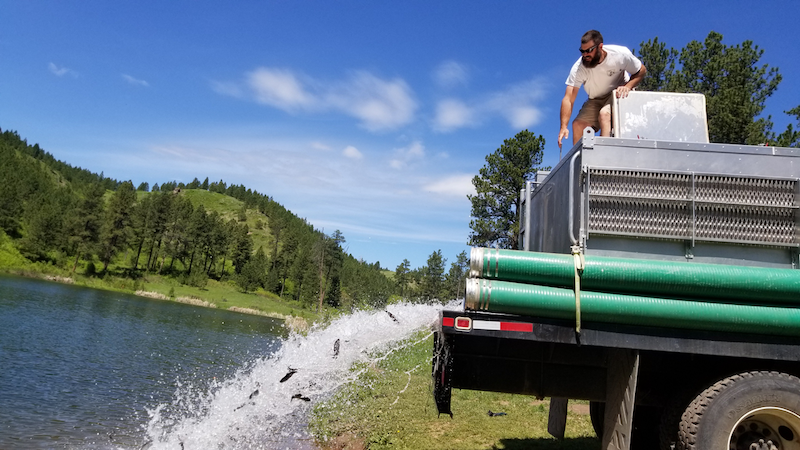
A truck dumps hatchery-raised rainbow trout into a lake in Montana.
Pheasants were introduced to North America from Asia in the late 1800s to provide trophy hunting opportunities. While these birds are prized by hunters, they often don’t thrive in introduced spaces, leading state agencies to spend time and tax dollars raising these birds just so they can be shot en masse when their season opens.
Another example is the European brown trout, which has been widely introduced into rivers and lakes in the U.S. to enhance recreational fishing. The problem? These trout often outcompete native fish species, such as cutthroat trout, for food and habitat. Brown trout also prey on native amphibians and aquatic insects, further disrupting the ecological balance. The introduction of brown trout highlights how prioritizing recreational fishing opportunities can harm native species (like this situation in Wyoming where pelicans were shot to protect a stocked lake) and degrade freshwater ecosystems.
Rainbow trout are perhaps the poster children of state wildlife management with the wrong priorities. They are only native to Pacific drainages and probably more widely raised and stocked than browns as GMOs (triploid, sterile so they won’t hybridize with native trout) fish. In fact, they are so widely stocked that IUCN includes them on its list of 100 most invasive species in the world.
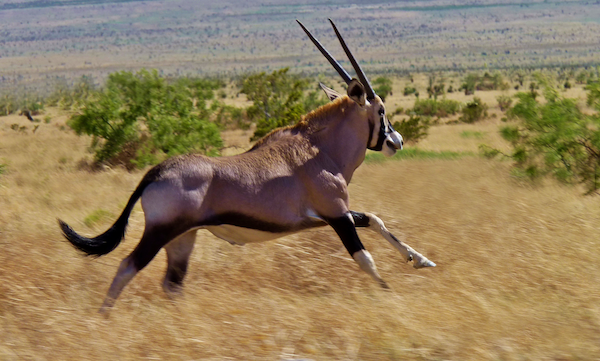
An Arabian oryx runs on BLM land near Las Cruces, New Mexico.
Perhaps the most glaring examples of harmful introductions are non-native ungulates like oryx, aoudad, and ibex, who have been released in parts of the American Southwest to create trophy hunting opportunities. These species, originally from Africa and Europe, have thrived in desert regions of the U.S., but their presence has come at a high cost.
- Oryx (also known as gemsbok) were introduced to New Mexico’s White Sands Missile Range in the 1960s. These large antelope were brought over from Africa to create an exotic trophy hunting experience. Now, oryx populations are expanding beyond their introduction site, threatening the sensitive desert ecosystem and competing with native species like mule deer for food and water. Yet, they are very popular with hunters and generate revenue for the New Mexico Department of Game and Fish. And perhaps most tellingly, the National Park Service had to erect a oryx fence around White Sands National Monument (now a National Park) to keep oryx out.
- Aoudad (or Barbary sheep) are native to North Africa but were introduced to the U.S. for trophy hunting in the mid-20th century. Aoudad populations are self-sustaining in Texas and New Mexico, where they outcompete native species like bighorn sheep for habitat and resources. The rapid spread of aoudad, which are well-adapted to harsh conditions, has made it even more difficult to restore and protect the populations of native desert bighorn sheep, of which some subpopulations are already imperiled (Peninsular bighorn sheep and Sierra Nevada bighorn sheep are endangered). NMDGF offers over the counter tags for Barbary sheep in the Sacramento Mountains where they want to establish bighorn sheep.
The False Promise of Hunter-Focused Wildlife Management
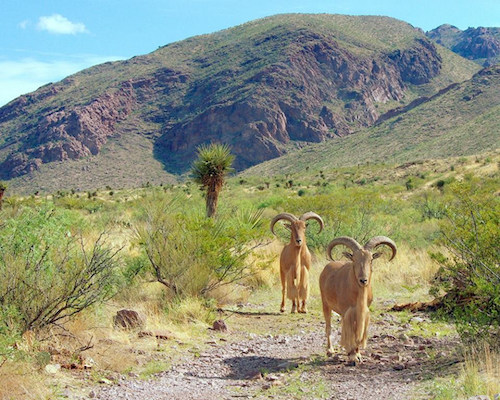
Barbary sheep in the mountain of Pena Blanca WSA, New Mexico BLM lands.
State wildlife agencies often argue that the introduction of non-native species and the focus on increasing hunter opportunities generate revenue that can be reinvested into conservation.
While it’s true that hunting licenses and fees contribute to the current model of state wildlife funding, this argument misses a critical point: conservation must focus on protecting ecosystems as a whole, not just managing game populations for human benefit. Prioritizing trophy hunter satisfaction over ecological integrity is just wrong and only furthers the decline of life on Earth.
It’s time for state wildlife agencies to modernize. In the face of the sixth mass extinction, every decision made by wildlife agencies should aim to restore and protect natural ecosystems, not exploit them. By focusing on short-term economic gain, we risk losing the very biodiversity that sustains life on Earth.
A Better Path Forward: Future-Focused Conservation
To address the biodiversity crisis, wildlife agencies must shift their priorities. They should focus on:
- Protecting and restoring native species: Agencies should concentrate on protecting the species and habitats that are most at risk, particularly in regions like the Southwest where fragile ecosystems are already under strain.
- Promoting coexistence: Education and programs that encourage coexistence between humans and wildlife—especially large predators like wolves, mountain lions, and bears—should be prioritized. These apex species are crucial for maintaining ecological balance, yet they are often marginalized in favor of game species.
- Sustainable funding for conservation: Rather than relying so heavily on hunting and fishing revenue, wildlife agencies need our help to advocate for diversified funding sources from state legislatures and the federal government. This could include conservation taxes, grants, and partnerships with environmental organizations. A broader funding base would allow agencies to prioritize biodiversity and ecosystem health without being beholden to the wash-rinse-repeat cycle of selling licenses, attracting more people to buy licenses, then selling more licenses. (Call us crazy, but that doesn’t seem like a good use of state wildlife agency time or dollars.)
- Science-based management: Decisions on wildlife management should be grounded in ecological science and ethics of coexistence, with the long-term goal of ecosystem health and biodiversity conservation.
It’s Time to Modernize State Wildlife Management
As we stand on the precipice of the sixth mass extinction—this one driven by human activity—wildlife management decisions are more critical than ever. Prioritizing hunter opportunity over conservation is shortsighted and harmful, especially when it involves the introduction of non-native species that further destabilize ecosystems. To protect biodiversity and ensure the health of our planet, wildlife agencies must shift their focus to long-term conservation goals.
The time has come for state wildlife agencies to shift their focus from merely catering to hunters and instead embrace their role as stewards of biodiversity. Only then can we hope to protect the intricate web of life that sustains our planet.
Biodiversity is the foundation of life, and without it, our world—and humanity—will suffer the consequences. The time to act is now, before it’s too late.
Rolling Stone: Inside the Growing and Controversial World of Wildlife-Killing Contests

Wildlife for All Executive Director Michelle Lute and founder Kevin Bixby are quoted in a new article from Rolling Stone, “Inside the Growing and Controversial World of Wildlife-Killing Contests.” Following the money, the piece details how millions of dollars have been doled out in competitions where hundreds of animal lose their lives, stirring up a culture war among hunters over questions of what it means to be an ethical hunter.
“This is part of a deeply problematic picture emerging about the gun lobby getting involved in promoting hunting to youth,” says Michelle Lute, the co-executive director of Wildlife for All. “And all of this is happening under the guise of conservation when it’s not.”
New Survey Reveals Strong Support for Wildlife Policy Reform
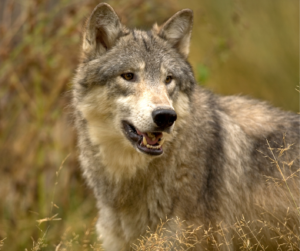
A new nationwide survey conducted by Colorado State University and Project Coyote reveals strong support for criminalizing acts of cruelty to wildlife. Between 77.5 and 85.8% of respondents said they would support various federal and state policies restricting killing of wild carnivores and banning practices such as running down wolves with snowmobiles.
The results also demonstrate the importance of raising awareness of the need for reform. While people are largely aware of animal cruelty in lab testing and factory farming, few realize the extent of the lack of protections for native carnivores. The majority of people surveyed were previously unaware that species like wolves, foxes, bobcats, and coyotes can be killed without limit across much of their range in North America. With few exceptions (such as cougars in California), states afford few legal protections for wild carnivores not classified as endangered, compared to other hunted big game species such as deer and elk.
The results showed:
- 74.1% of respondents originally believed that “for all carnivore species (e.g. coyotes, bobcats, and foxes), there are limits in my state on the number that can be killed by a hunter in one season” prior to taking the survey (false for all states).
- 85.8% of respondents supported federal legislation criminalizing cruelty to wildlife
- 80.2% backed banning the use of snowmobiles to run over wildlife
- 81.7% supported state laws banning wildlife killing contests and restricting hunting seasons for carnivores
- 78.2% supported banning wildlife killing contests under federal law
- 77.5% supported mandating bag limits for all carnivores under federal law
Representing Colorado State University’s Animal-Human Policy Center, Dr. Rebecca Niemiec stated: “We found that the United States public strongly supports a variety of animal protection policies, especially policies that reduce suffering among wild carnivores. However, we also found that the public underestimates the extent to which others in the country care about these issues. By correcting these perceptions, we can show the public and policymakers that reducing animal suffering is indeed a priority for the vast majority of Americans.”
Representing Project Coyote, Renee Seacor stated: “The legal, relentless persecution of wild carnivores doesn’t match broad public values in the United States. This survey conducted in partnership with the Animal-Human Policy Center provides essential data for our ongoing policy reform work and will help convince policymakers to take more immediate action to address the mismanagement of our nation’s wildlife. Thanks to the support of Coyote Collective members, we will continue collaborating with researchers, like-minded organizations, wildlife advocates, and policymakers to safeguard our nation’s wild carnivores from unjust and unscientific persecution.”
Read a fact sheet about the survey here.
View the survey results in full here.