
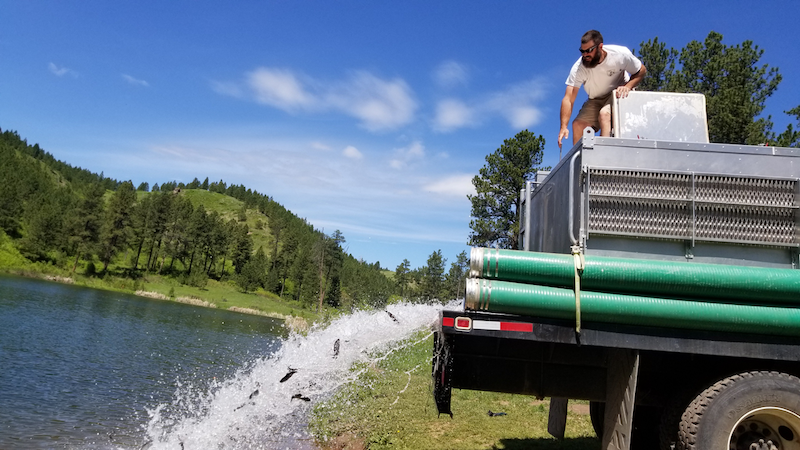
Rainbow trout stocking
A recent article from Vox, featuring Wildlife For All’s Michelle Lute and Mandy Culbertson, discusses fish stocking. State wildlife agencies regularly release brown trout, rainbow trout, largemouth bass, and other species into waterways. These fish are nonnative to local ecosystems. At the same time, agencies warn us about the dangers of invasive species.
What’s wild is that’s not a contradiction; it’s a system doing exactly what it was designed to do. Nonnative fish stocking persists largely due to funding – state wildlife departments depend heavily on revenue streams from fishing licenses. That creates a built-in incentive to keep stocking fish people want to catch, regardless of ecological costs. Due to structural dependence on sportfish species, agencies also use Dingell-Johnson grant funding for this purpose.
Some fish releases have had profound environmental consequences. From 1974 to 1985, the Virginia Department of Game and Inland Fisheries (now the Department of Wildlife Resources) introduced blue catfish into the Chesapeake Bay for sport fishing opportunities. Today, blue catfish are considered a highly invasive species in the Bay, out-competing many native fish and disrupting the ecosystem. Anglers prize blue catfish, making this fish an economic incentive for commercial fisheries. However, their proliferation also harms native species like striped bass, menhaden, shad, alewive, river herring, and blue crabs – and can disrupt critical habitat conservation work.
The science is clear: stocked fish can displace native species, restructure food webs, harm amphibians and birds, and erode genetic integrity through hybridization. In some places, like alpine lakes, they’re added to waters that never had fish at all, fundamentally rewriting those ecosystems. This isn’t conservation: this is what captured wildlife governance looks like. Instead of fixing degraded habitats, warming waters, and collapsing ecosystems, the system patches over the damage with species that keep revenue flowing.
Instead of addressing the root causes of biodiversity decline—habitat loss, warming waters, degraded ecosystems—we manage around the damage. We replace what’s been lost with what’s profitable. It’s easier to stock fish than to restore ecosystems. It’s more profitable to maintain demand than to rebuild biodiversity. So that’s what the system delivers.
So what’s the solution? It isn’t tweaking around the edges; it’s changing the structure. State wildlife agencies are public institutions and they should serve the public trust, not a funding model tied to extraction and use. That means funding that reflects all wildlife views and outdoor users, decision-making grounded in science and values, and accountability to ecosystem health, not just license sales. Because right now, they’re not managing wildlife. They’re managing revenue streams, and ecosystems are paying the price.
Join us in pushing for state wildlife governance that works for biodiversity, democracy, and all life, not just the bottom line.
